Upto 51% OFF & FREE UK-MAINLAND DELIVERY ON ALL ORDERS
What Size Air Compressor Do I Need? UK Buyer's Guide
Whether you're a first-time buyer or upgrading from an old compressor, choosing the right size air compressor can feel overwhelming. Tank sizes, CFM ratings, bar pressure, oil-free vs oiled — there's a lot to consider. This guide cuts through the jargon and helps you choose the right compressor for your tools, your workspace, and your budget.
The short answer: The right size compressor depends on three things — what tools you're running, how many tools you're running at the same time, and how continuously you need to run them. Get these three things right and you'll never under or overbuy.
Step 1 — What Tools Are You Running?
Every pneumatic tool has a CFM (Cubic Feet per Minute) or L/min requirement — the amount of air it needs to operate properly. Here are the most common tools and their air requirements:
| Tool | CFM Required | L/min Required |
|---|---|---|
| Brad/finish nailer | Under 1.0 CFM | Under 28 L/min |
| Touch-up spray gun | ~2.5 CFM | ~70 L/min |
| Air drill | 3-6 CFM | 85-170 L/min |
| Framing nailer | 2.2-2.4 CFM | 62-68 L/min |
| HVLP spray gun (full size) | 4.6-5.6 CFM | 130-160 L/min |
| 1/2" impact wrench | 5-7 CFM | 140-200 L/min |
| Air ratchet | 4-6 CFM | 113-170 L/min |
| Orbital sander (large) | ~12 CFM | ~340 L/min |
| Tyre inflation | Under 1.0 CFM | Under 28 L/min |
The golden rule: your compressor's FAD (Free Air Delivery) must be higher than the CFM requirement of your tool. If your compressor can't keep up with the tool's demand, pressure will drop and performance will suffer.
Step 2 — How Many Tools Are You Running Simultaneously?
Running one tool at a time? A smaller compressor will do the job. Running multiple tools at the same time — like on a busy job site — you need to add up the CFM requirements of all the tools running together.
For example: a framing nailer (2.4 CFM) + medium HVLP spray gun (5.0 CFM) = 7.4 CFM total. Your compressor needs to deliver at least 7.4 CFM at working pressure to keep both tools running without dropping pressure.
Step 3 — How Continuously Do You Need to Run?
This is where tank size matters. A larger tank stores more air — meaning the compressor motor cycles on less frequently to top up the pressure. For continuous heavy use like spray painting a whole car or running a sander for hours, a larger tank keeps pressure more consistent and reduces motor wear.
For intermittent use — firing a nail gun occasionally or inflating a tyre — a smaller tank is perfectly adequate because the compressor has time to recover between uses.
Which TEH Tools Compressor Do You Need?
| Model | FAD @ 8 Bar | Best For |
|---|---|---|
| LAC3L | 30 L/min (1.05 CFM) | Tyre inflation, sports equipment, light DIY |
| TAC24L | 100 L/min (3.5 CFM) | Home DIY, brad nailers, touch-up spray guns |
| TAC50L-M1 | 100 L/min (3.5 CFM) | Trade use, spray guns, nailers, clean air applications |
| TAC50L Twin | 200 L/min (7.0 CFM) | Professional workshop, framing nailers, HVLP spray guns |
| TAC100L Triple | 300 L/min (10.6 CFM) | Industrial, full-size HVLP, orbital sanders, 4 tools simultaneously |
| TAC130L Quad | 400 L/min (14.1 CFM) | Heavy industrial, bodyshop, up to 6 tools simultaneously |
Quick Buying Guide by User Type:
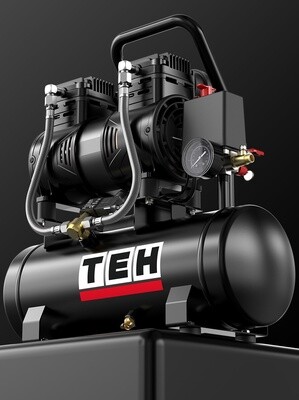
Home DIYer: You're inflating tyres, occasionally firing a brad nailer, and doing the odd touch-up spray job. The TAC24L is perfect — compact, quiet at 75-80dB, and handles everything a home DIYer needs.
Light Trade: You're a tradesperson using nailers, spray guns, and air drills on site. The TAC50L-M1 gives you a 50-litre tank and clean oil-free air — enough for a full day's work across most trade applications.
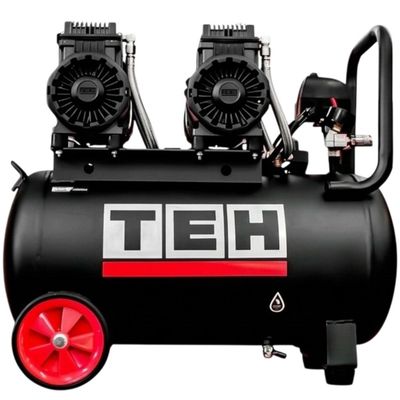
Professional Workshop: You're running HVLP spray guns, framing nailers, and multiple tools. The TAC50L Twin Motor with 200 L/min FAD at 8 Bar handles everything a busy workshop or professional trade site demands.
Industrial & Bodyshop: You need continuous high-volume airflow for orbital sanders, full-size spray guns, and multiple operators. The TAC100L or TAC130L are built for exactly this — triple and quad motor configurations with intelligent controllers.
Common Mistakes to Avoid:
- Buying on tank size alone — a 50L compressor with low CFM output is worse than a 24L compressor with high CFM output for continuous tool use
- Ignoring FAD figures — max displacement figures are theoretical; always check the FAD at working pressure
- Underbying for future needs — if you think you might add more tools later, size up now
- Forgetting about noise — if you're working at home or in a residential area, check the dB rating. Our TAC24L at 75-80dB is significantly quieter than most compressors in its class
NEW in
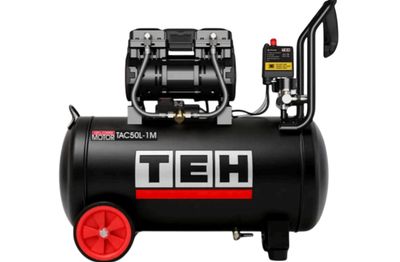
TEH 50L Oil-Free Air Compressor 1500W 2HP | Dual Gauge 250 L/min | 8 Bar 116 PSI | Trade & Professional Use
TEH 50L Oil-Free Air Compressor 1500W 2HP | Dual Gauge 250 L/min | 8 Bar 116 PSI | Trade & Professional Use
Supports Single & Multi-Tool Operation — Perfect for Workshop, Trade & Clean Air Applications.
SKU TAC50L-M1
£199.17
NEW in

TEH LAC3L Cordless Battery Air Compressor 3L | 7 Bar 101 PSI | 30 L/min | Tyre Inflation & Emergency Roadside Use
TEH LAC3L Cordless Battery Air Compressor 3L | 7 Bar 101 PSI | 30 L/min | Tyre Inflation & Emergency Roadside Use
Cordless & Battery Powered | 7 Bar 101 PSI | 30 L/min | Car Tyres, Bikes, Sports Equipment & Light DIY | Emergency Roadside Ready
SKU LAC3L
was £332.50
Save 38%
£207.50
On Sale
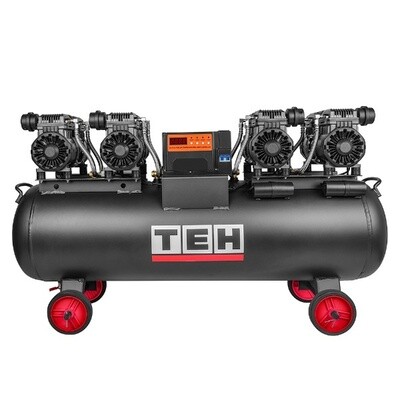
TEH TAC130L 130L Oil-Free Air Compressor Quad Motor 8HP | 400 L/min 14.1 CFM FAD | 8 Bar 116 PSI | Intelligent Controller | Industrial & Bodyshop
TEH TAC130L 130L Oil-Free Air Compressor Quad Motor 8HP | 400 L/min 14.1 CFM FAD | 8 Bar 116 PSI | Intelligent Controller | Industrial & Bodyshop
Quad Motor 8HP | 400 L/min 14.1 CFM FAD @ 8 Bar | Runs Full-Size HVLP, Multiple Orbital Sanders & Up To 6 Simultaneous Tools | Intelligent Controller
SKU TAC130L
was £1 374.17
Save 46%
£745.83
On Sale
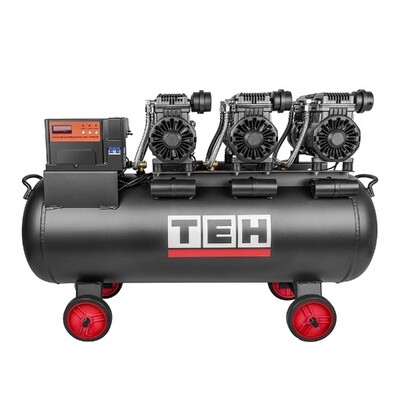
TEH TAC100L 100L Oil-Free Air Compressor Triple Motor 6HP | 300 L/min 10.6 CFM FAD | 8 Bar 116 PSI | Intelligent Controller Industrial Use
TEH TAC100L 100L Oil-Free Air Compressor Triple Motor 6HP | 300 L/min 10.6 CFM FAD | 8 Bar 116 PSI | Intelligent Controller Industrial Use
Triple Motor 6HP | 300 L/min 10.6 CFM FAD @ 8 Bar | Runs Full-Size HVLP, Orbital Sanders & Up To 4 Simultaneous Tools | Intelligent Controller
SKU TAC100L
was £912.50
Save 37%
£579.17
On Sale
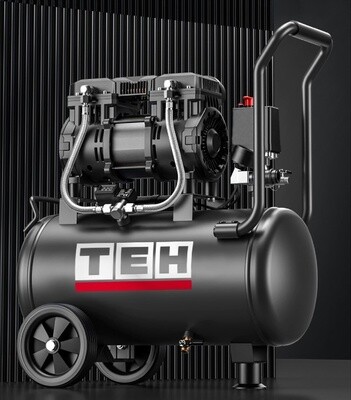
TEH 24L Oil-Free Air Compressor 1500W 2.5HP | Dual Gauge | 250 L/min | 8 Bar 116 PSI | Home & Light Trade
TEH 24L Oil-Free Air Compressor 1500W 2.5HP | Dual Gauge | 250 L/min | 8 Bar 116 PSI | Home & Light Trade
Runs Nailers, Spray Guns & Air Drills — Low Noise 70-75dB | 100% Oil-Free & Maintenance-Free.
SKU TAC24L
was £140.83
Save 14%
£120.79
Display prices in:GBP