Upto 51% OFF & FREE UK-MAINLAND DELIVERY ON ALL ORDERS
How to Use an Electric Paint Spray Gun — Beginner's Guide
An electric paint spray gun transforms painting jobs that would take hours with a brush or roller into a quick, even, professional-looking finish. Fences, garden furniture, sheds, interior walls, metal gates — a spray gun covers large surfaces fast and reaches into corners and details that brushes struggle with. Here's how to get great results every time.
How Does an Electric Spray Gun Work?
An electric spray gun uses a built-in motor and fan to atomise paint — breaking it into tiny droplets and projecting them onto the surface in a controlled spray pattern. Unlike compressed air spray guns that require a separate compressor, electric spray guns are completely self-contained — just plug in, fill the container, and spray.
The TEH TSG4005 400W electric spray gun is perfect for fences, sheds, garden furniture, walls, and metal surfaces — with an 800ml container, adjustable nozzle, and flow control knob.
Before You Start — Preparing Your Paint
The most common mistake with electric spray guns is using paint that's too thick. Paint needs to be thinned to the correct viscosity before spraying — thick paint blocks the nozzle, produces an uneven pattern, and strains the motor.
How to thin paint:
- Water-based paints (emulsion, acrylic) — thin with water, typically 10-20%
- Oil-based paints — thin with the appropriate solvent per manufacturer instructions
- Test viscosity by filling a cup and timing how long it takes to empty through a small hole — most spray guns work best with paint that flows freely
Viscosity test: Dip a wooden stirrer in the thinned paint and lift it out. The paint should flow off in a continuous, slightly thin stream. If it drips in blobs, it's too thick. If it runs like water, it's too thin.
The TEH TSG4005 handles paint up to 60 din/s viscosity — always check your paint is within this range before spraying.
Setting Up the Spray Gun
Step 1 — Fill the container: Pour your thinned paint into the 800ml container. Don't overfill — leave a small gap at the top.
Step 2 — Adjust the nozzle: Rotate the nozzle to select your spray pattern:
- Vertical fan — for horizontal surfaces like floors and table tops
- Horizontal fan — for vertical surfaces like walls and fences
- Round pattern — for small, detailed areas
Step 3 — Set the flow control: Start with the red flow control knob at approximately halfway. You can increase or decrease flow once you've tested the pattern.
Step 4 — Test spray: Always test on cardboard first. Check the pattern is even, the flow rate is consistent, and the coverage is what you need. Adjust flow and distance before spraying your actual surface.
Spraying Technique
Distance: Hold the gun approximately 20-30cm from the surface. Too close causes runs and drips. Too far produces a dry, uneven finish.
Speed: Move the gun at a consistent speed — too slow causes runs, too fast leaves thin patches. Aim for a smooth, steady pass taking approximately 1-2 seconds per metre.
Overlap: Each pass should overlap the previous one by approximately 50% — this ensures even coverage without stripes.
Angle: Keep the gun perpendicular to the surface — tilting causes uneven coverage.
Wet edge: Always maintain a wet edge — spray the next pass before the previous one fully dries to avoid visible overlap lines.
What Can You Spray?
- Garden fences and decking — cover large areas in minutes vs hours with a brush
- Sheds and outbuildings — even coverage on rough timber
- Garden furniture — smooth, professional finish on wood and metal
- Interior and exterior walls — faster than rolling for large areas
- Metal gates and railings — reaches into corners and decorative details
- Primers and undercoats — even base coat application
Cleaning Your Spray Gun — Essential
Clean the gun immediately after every use — dried paint in the nozzle or container will block it and ruin future spray patterns.
- Empty remaining paint from the container
- Fill container halfway with clean water (for water-based paints) or appropriate solvent
- Spray through until clean water/solvent runs clear
- Disassemble the nozzle and wipe clean
- Store disassembled to allow all parts to dry completely
Troubleshooting Common Problems:
| Problem | Cause | Solution |
|---|---|---|
| Uneven pattern | Paint too thick | Thin paint further |
| Runs and drips | Too close or too slow | Increase distance, speed up movement |
| Dry patchy finish | Too far or too fast | Decrease distance, slow down movement |
| Blocked nozzle | Paint dried in nozzle | Disassemble and clean thoroughly |
| Spitting | Paint too thick or air bubbles | Thin paint, stir thoroughly |
On Sale
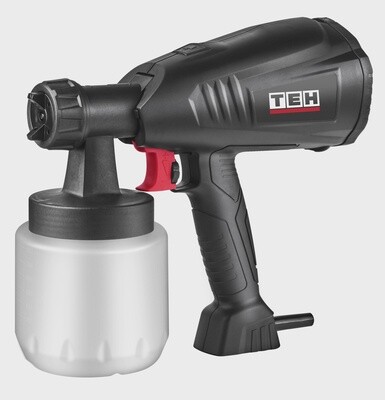
TEH 400W Electric Paint Spray Gun | 800ml Container | Adjustable Nozzle | Flow Control | Wood Metal & Walls
TEH 400W Electric Paint Spray Gun | 800ml Container | Adjustable Nozzle | Flow Control | Wood Metal & Walls
400W | 800ml Container | Adjustable Spray Nozzle | Flow Control Knob | Max 60din/s Viscosity | Wood, Metal, Walls & Fences | 1 Year Warranty
SKU TSG4005
was £65.83
Save 56%
£29.17
Display prices in:GBP