Upto 51% OFF & FREE UK-MAINLAND DELIVERY ON ALL ORDERS
How to Use a Mitre Saw — Beginner's Guide to Accurate Cuts
A mitre saw is the fastest way to make accurate crosscuts, angle cuts, and bevel cuts in timber, MDF, and other materials. Once you've used one, going back to a hand saw or circular saw for repeat cuts feels impossibly slow. Here's everything you need to know to get started.
Types of Mitre Saw
Compound Mitre Saw (Fixed Head): Makes straight crosscuts and angled mitre cuts left and right. The head also tilts for bevel cuts. Cannot cut wider boards than the blade diameter allows. The TEH TMS25518 255mm 1800W is a compound mitre saw — compact, lightweight, and ideal for site work and everyday carpentry.
Sliding Compound Mitre Saw: Adds sliding rails that extend the cutting capacity — allowing wider boards and panels to be cut cleanly. The TEH TMS25519 255mm Sliding 1800W is our sliding model — the better choice for workshop use or anyone cutting wider materials regularly.
Fixed vs Sliding — Which Do You Need?
| Feature | TMS25518 Fixed | TMS25519 Sliding |
|---|---|---|
| Cutting width | Standard | Wider boards & panels |
| Size & weight | More compact | Larger |
| Best for | Site work & everyday cuts | Workshop & wider materials |
| Price | Lower | Higher |
Understanding the Cuts
Crosscut: A straight 90° cut across the width of the timber. The most common cut — used for trimming timber to length.
Mitre cut: An angled cut left or right across the face of the timber. Used for picture frames, architrave joins, and any corner joint where two pieces meet at an angle. Most mitre saws have detented stops at the most commonly used angles — 15°, 22.5°, 30°, and 45°.
Bevel cut: The head tilts to cut at an angle through the thickness of the timber. Used for cutting bevelled edges on decking, roof timbers, and angled joints.
Compound cut: A combination of mitre and bevel simultaneously — used for complex profiles like crown moulding and complex roof angles.
Step-by-Step: Making an Accurate Crosscut
- Ensure the saw is on a stable, level surface
- Set the mitre angle to 0° (straight) and lock
- Set the bevel to 0° and lock
- Place the timber against the fence — the vertical backstop
- Hold the timber firmly against the fence with your free hand — keep fingers well clear of the blade line
- Switch on the saw and allow it to reach full speed
- Bring the blade down smoothly through the timber
- Allow the blade to stop completely before lifting the head
- Release the trigger
Step-by-Step: Making a 45° Mitre Cut
- Release the mitre lock and rotate the table to 45°
- The detented stop will click at 45° — lock it in place
- Proceed as for a crosscut
- For a picture frame or architrave corner, cut one piece at 45° left and the matching piece at 45° right — they should fit together perfectly
Tips for Perfect Results:
- Mark your cut line clearly before cutting — use a sharp pencil and a square
- Use the laser guide line (TMS25519) for precise cut placement before committing
- Always support long pieces — an unsupported length of timber can drop and cause a poor cut or kickback
- Use the workpiece clamp for small pieces — never hold small pieces by hand near the blade
- Let the blade do the work — don't force it down
- For MDF and sheet materials, a fine-tooth blade (80T) gives cleaner, splinter-free edges
- Essential Mitre Saw Safety:
- Always wear safety glasses and hearing protection
- Never reach across the blade line
- Keep both hands well away from the blade — use the workpiece clamp for small pieces
- Allow the blade to stop completely before lifting the head or moving the workpiece
- Never cut freehand — always use the fence
- Keep the blade guard in place at all times
On Sale
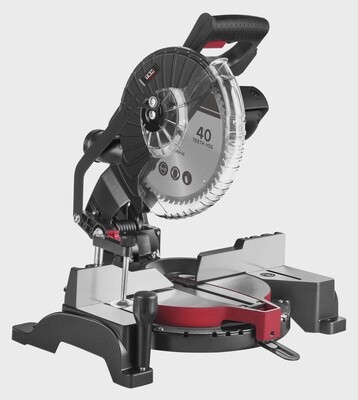
TEH 255mm 10" Compound Mitre Saw 1800W | Single Bevel 45° | 4600 RPM | 40T HSS Blade | Wood Plastic & Aluminium
TEH 255mm 10" Compound Mitre Saw 1800W | Single Bevel 45° | 4600 RPM | 40T HSS Blade | Wood Plastic & Aluminium
1800W | 255mm 10" Blade | Single Bevel 0-45° | Detented Angle Stops | 40 Tooth HSS Blade | Dust Port | Cuts Wood, Plastic & Aluminium | 1 Year Warranty
SKU TMS25518
was £220.83
Save 44%
£124.17
On Sale
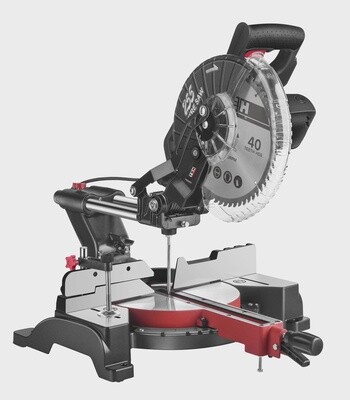
TEH 255mm 10" Sliding Compound Mitre Saw 1800W | Single Bevel 45° | 4600 RPM | Wood Plastic & Aluminium | Garden & Workshop
TEH 255mm 10" Sliding Compound Mitre Saw 1800W | Single Bevel 45° | 4600 RPM | Wood Plastic & Aluminium | Garden & Workshop
1800W | 255mm 10" Blade | Single Bevel 0-45° | Sliding Rails | Laser Guide | 40 Tooth HSS Blade | Cuts Wood, Plastic & Aluminium | 1 Year Warranty
SKU TMS25519
was £258.33
Save 37%
£162.50
Display prices in:GBP